

Omaha Poker Rules and How They Differ from Hold'em
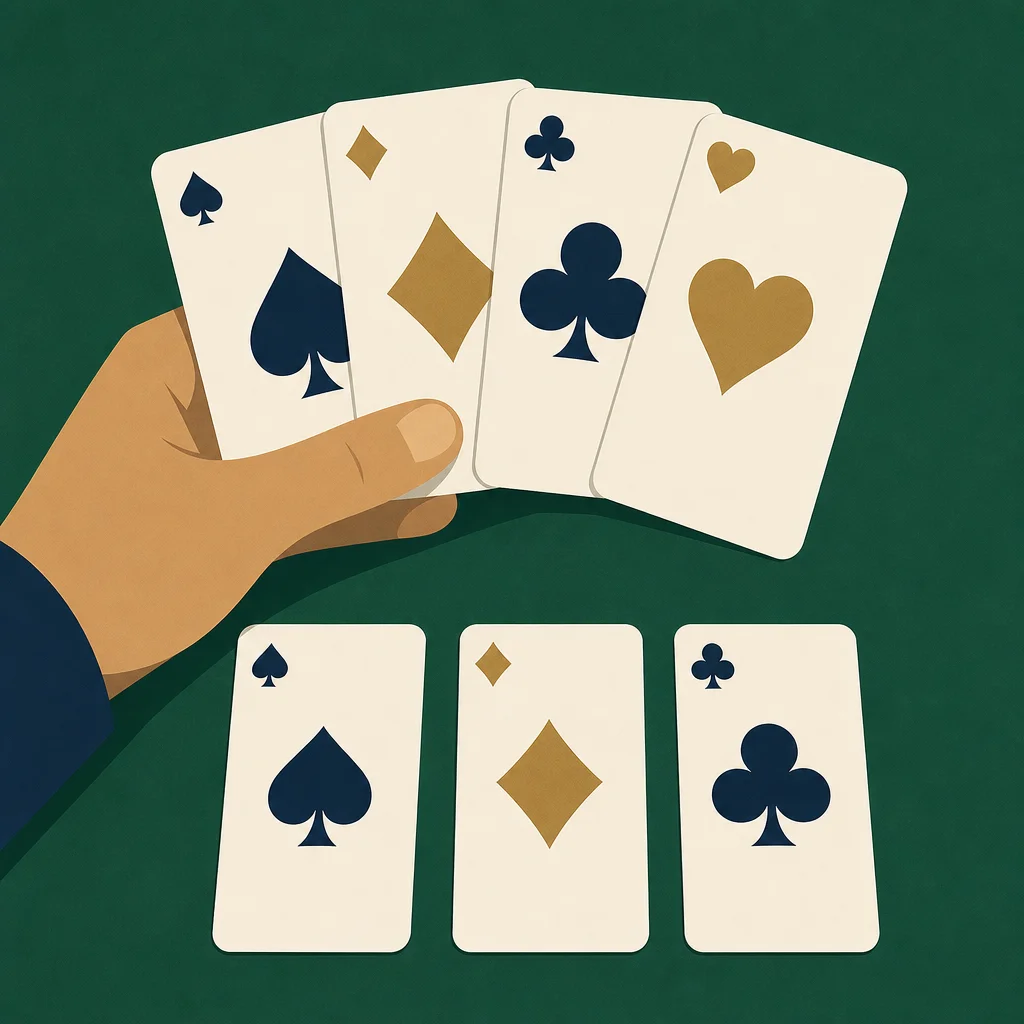
Omaha poker rules define a community-card poker variant in which each player receives four hole cards instead of two and must use exactly two of them, combined with exactly three community cards, to form a final hand. The variant is most often played as Pot-Limit Omaha, or PLO, where bet sizes are capped by the size of the pot rather than left open as in no-limit games. For a reader who already knows Texas Hold'em, the core shift lies in three areas: the four-card starting hand and its two-from-hand requirement, the pot-limit betting structure that governs most Omaha tables, and the optional hi-lo split format that pays out two ways instead of one.
The betting rounds themselves — preflop, flop, turn, and river, with the same order of action around the table — work the same way they do in Hold'em. For a full breakdown of how a betting round proceeds, see the site's dedicated betting rules entry, which applies across variants including Omaha.
Omaha Poker Rules for the Two-From-Hand Requirement
The defining rule of Omaha is arithmetic, not strategic: every showdown hand must use exactly two hole cards and exactly three board cards, no more and no fewer. This is a fixed structural rule of Omaha poker rules, not a house option, and it holds at every stake and format.
In Hold'em a player may use zero, one, or two hole cards freely, which is why the board alone sometimes plays. Omaha removes that flexibility. A player holding four aces plus a random pair, for example, cannot claim quads if the board shows only one ace — two of those four aces are dead weight unless paired with the right board texture.
Common Misconception
Pot-Limit Structure in the Rules of PLO Poker
Most tables using the rules of PLO poker cap every bet or raise at the current size of the pot, rather than allowing an all-in shove of any size. A player calculates the maximum raise by adding the current pot, any calls already made, and the amount required to call, then may raise by that combined total.

This cap changes hand values compared with no-limit Hold'em. Stacks grow more slowly relative to the pot, drawing hands stay playable deeper into a hand, and preflop all-in confrontations happen less often. Four-card starting hands also run closer in raw equity than two-card Hold'em hands.
| Element | Texas Hold'em | Omaha (PLO) |
|---|---|---|
| Hole cards dealt | 2 | 4 |
| Cards used at showdown | 0, 1, or 2 hole cards, any mix | Exactly 2 hole cards, always |
| Common betting structure | No-limit or limit | Pot-limit (most common) |
| Preflop equity gaps | Wider between hands | Narrower between hands |
Hi-Lo Split Conditions in Omaha Poker Rules
A second major branch of Omaha poker rules governs Omaha Hi-Lo, sometimes labeled Omaha/8. In this format the pot splits between the best high hand and the best qualifying low hand, and a single player can scoop the entire pot by holding both at once.
A low hand only qualifies if a player can form five unpaired cards of rank eight or lower, using the same two-from-hand and three-from-board rule described above. If no player holds a qualifying low at showdown, the entire pot goes to the best high hand instead, the same as standard Omaha. The method for ranking two low hands against each other is covered in the site's hand rankings by variant guide.
Reading a Hi-Lo Board
How to Play Omaha Poker Rules Step by Step
- Each player receives four hole cards face down, dealt clockwise from the dealer button.
- A round of betting follows preflop, using the same blind and action order found in Hold'em.
- The flop reveals three community cards, followed by another betting round.
- The turn adds a fourth community card, followed by another betting round.
- The river adds the fifth and final community card, followed by the last betting round.
- At showdown, each remaining player selects exactly two hole cards and exactly three community cards to form the best five-card hand — or, in Hi-Lo, the best qualifying high and low combinations.
This sequence explains omaha poker rules for beginners moving over from Hold'em: dealing and betting stay familiar, while the hand-construction rule and the pot-limit cap take the most practice to internalize.