

Best Poker Hands: Strength, Nuts and Win Rates
The best poker hands are the holdings and made hands that win most often, measured by three numbers: raw equity against a random hand, equity against a realistic range, and observed win rate over many hands. Pocket aces sit at the top of the best poker hands list preflop, winning close to 85% of the time against one random hand. Made hands are ranked on a separate ladder, from a pair up to a royal flush, and the strongest possible made hand on a given board is called the nuts.
Reading a poker hands strength chart gives a snapshot of equity, but equity alone does not decide a session. A good poker hand can still lose if it is played into the wrong spot, and a modest hand can post a strong win rate if it is selected well. This entry separates the three measures and shows how each one defines the best poker hands to play.

How Hand Rankings Set the Baseline for Strength
Every made hand sits on a fixed ladder, from high card at the bottom to a royal flush at the top, and that ladder never changes regardless of the game. A poker hands strength chart uses this ladder to compare holdings at a glance, which helps beginners tell good poker hands from weak ones. The full order, and which combination sits at its peak, is covered in the highest hand in poker entry.
Hand rankings only describe strength at showdown, though. Before the board is complete, the best poker hands are judged by equity instead — the share of the pot a hand expects to win if the remaining cards were dealt immediately. A hand can rank low on the showdown ladder yet still hold strong equity, such as a flush draw against a lone overpair.
The Best Starting Hands by Raw Equity
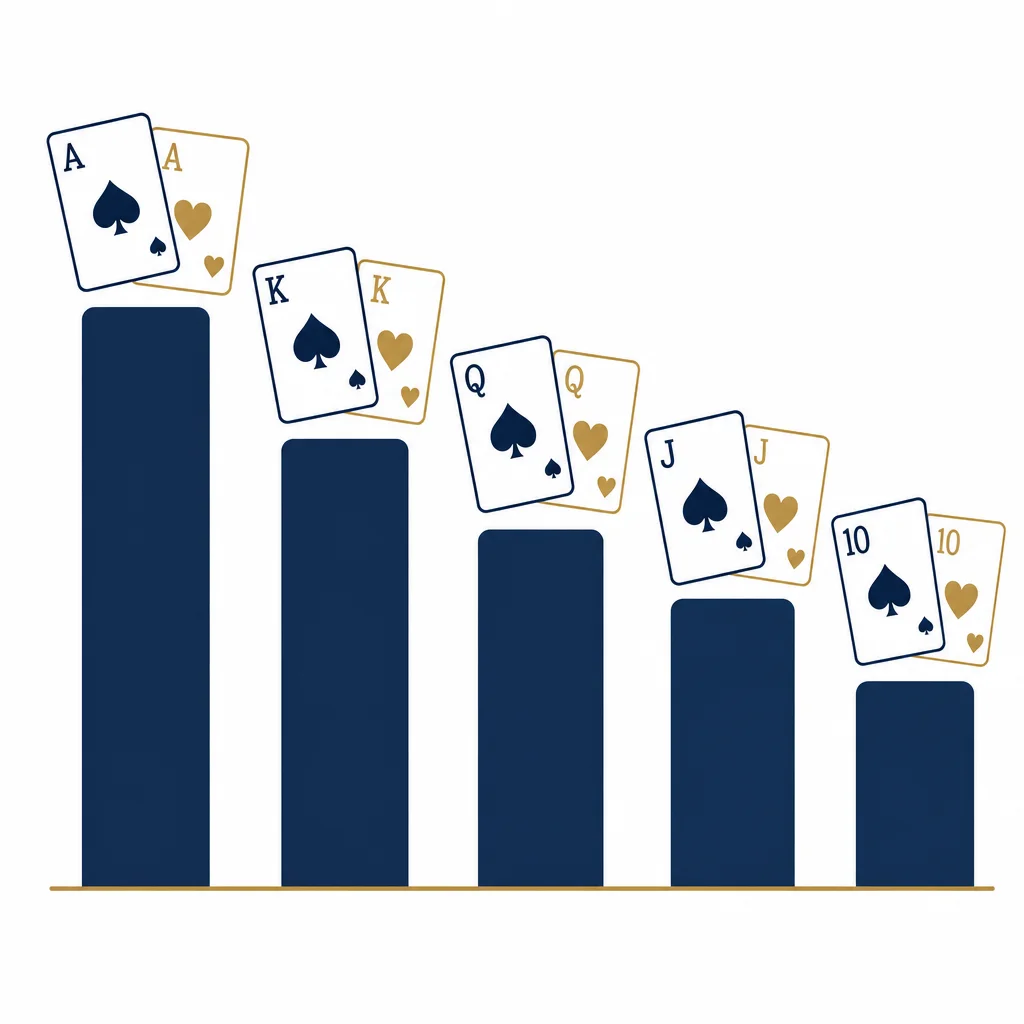
Preflop, the best hand in poker by raw equity is pocket aces, holding close to 85% equity against one random hand, according to equity data published by CoinPoker and PokerTube. Pocket kings follow at roughly 82% against a random hand, and ace-king suited sits well behind both pairs despite its reputation as a premium holding. These numbers shift once a range narrows — aces still lead kings, but only by about 82% to 18% when the two collide directly, per Poker Academy's equity data.
| Starting Hand | Equity vs Random Hand | Category |
|---|---|---|
| Pocket Aces (AA) | ~85% | Premium pair |
| Pocket Kings (KK) | ~82% | Premium pair |
| Pocket Queens (QQ) | ~80% | Premium pair |
| Ace-King Suited (AKs) | ~67% | Premium broadway |
| Ace-King Offsuit (AKo) | ~65% | Strong broadway |
This table covers only the top of the range. A full breakdown of which hands are worth playing from each position, including suited connectors and smaller pairs, belongs to the dedicated starting hands guide rather than this entry. For terms like equity and range used throughout this ladder, see the site glossary.
The Nuts, Win Rate and Best Poker Hands and Odds
Once the board is complete, the strongest possible made hand given the visible cards is called the nuts. The term exists because that hand cannot be beaten on that specific board — it is the ceiling of hand strength for the situation, not a fixed combination like a royal flush. A full explanation of what sits at the top of the made-hand ladder overall lives on the highest hand in poker page.
Win rate measures something different: how a hand or strategy performs across thousands of real hands, usually expressed in big blinds won per 100 hands (bb/100). A good poker hand win rate for a disciplined player in online cash games typically falls between 5 and 10 bb/100. High raw equity does not guarantee a high win rate, since a player who overvalues strong starting hands and misplays them can still post a losing rate over time.
Equity vs Win Rate
Best poker hands and odds are two sides of the same coin: odds describe the probability of completing or improving a hand, while equity converts that probability into a share of the pot. A flush draw with nine outs after the flop holds roughly 35% equity to complete by the river, which is why odds and equity are read together when judging real hand strength. For the formal reference treatment of this material, see Wikipedia's poker article.