

Poker Hands in Order from Highest to Lowest
Poker hands in order run from the royal flush at the top down to high card at the bottom, forming a ten-tier ranking that decides every showdown in standard poker. This ranking applies across most poker variants, including Texas Hold'em and Omaha, whenever five cards are compared. The list below sets out poker hands ranked in order, first from strongest to weakest and then reversed, each with one example.
A player does not need to memorize the reasoning behind the order to use it. This entry lists the ten categories, top to bottom and bottom to top, with a single example of each. For the tie-break rules that decide which hand wins when two players hold the same category, see the entry on poker hand rankings. For reordered hand rankings used in specific variants, see hand rankings by variant.
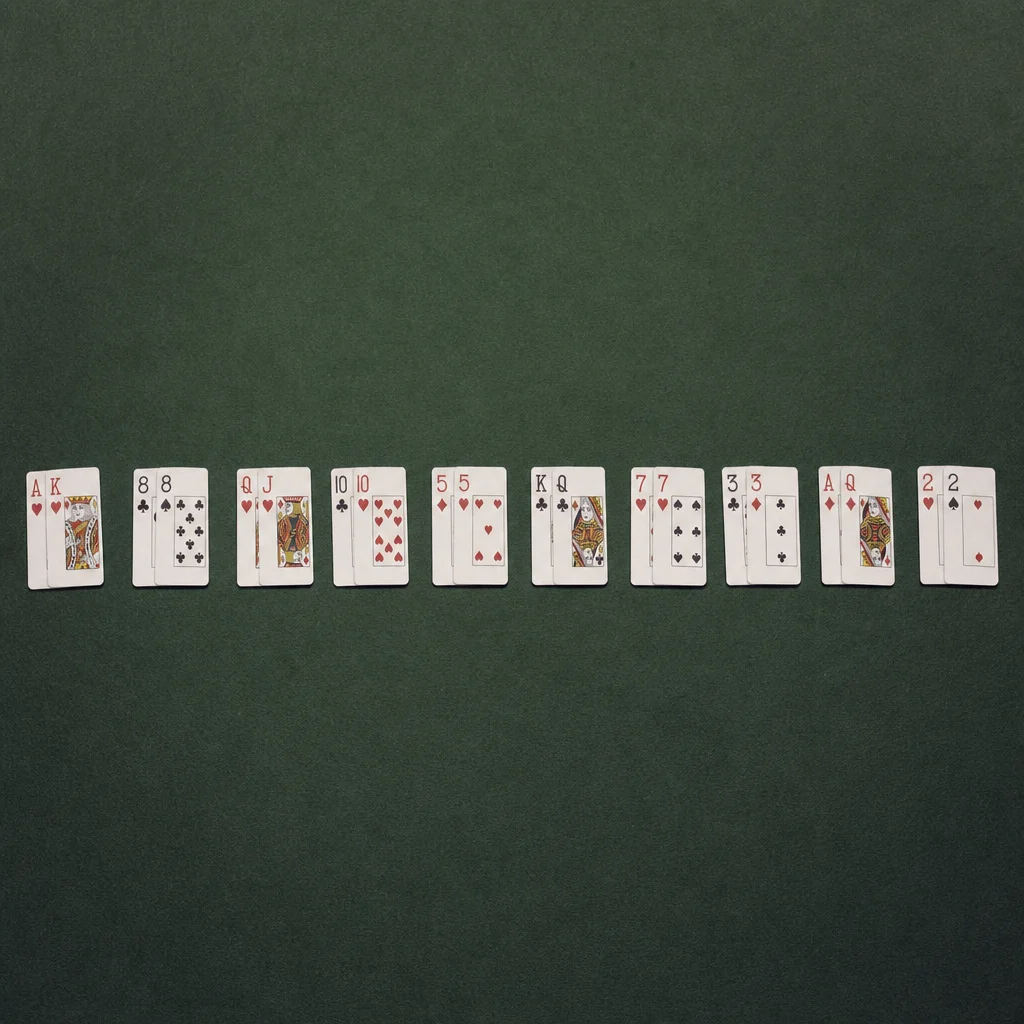
Poker Hands Highest to Lowest
The following sequence lists winning poker hands in order, starting with the rarest and most powerful combination and ending with the weakest hand that can still take a pot.
- Royal flush: A-K-Q-J-10, all of the same suit, such as the ace-high spade run A♠ K♠ Q♠ J♠ 10♠.
- Straight flush: Five consecutive cards of one suit, such as 9♥ 8♥ 7♥ 6♥ 5♥.
- Four of a kind: Four cards of the same rank, such as four jacks plus any fifth card.
- Full house: Three of a kind combined with a pair, such as three eights and two fours.
- Flush: Five cards of the same suit in any order, such as K♣ 9♣ 7♣ 4♣ 2♣.
- Straight: Five consecutive cards of mixed suits, such as 10-9-8-7-6.
- Three of a kind: Three cards of matching rank, such as three queens plus two unrelated cards.
- Two pair: Two separate pairs, such as a pair of tens and a pair of fives.
- One pair: A single matching pair, such as two aces plus three unrelated cards.
- High card: No pair or pattern, ranked by the highest single card, such as an ace-high hand.
Poker Hands Lowest to Highest
Reading the poker hands order chart in reverse shows the same ten categories building from the weakest hand toward the strongest.
High card sits at the bottom, followed by one pair, then two pair. Three of a kind ranks above two pair, and a straight outranks three of a kind. A flush beats a straight, and a full house beats a flush. Four of a kind sits above a full house, a straight flush outranks four of a kind, and the royal flush — technically the highest possible straight flush — sits at the very top of the order.
Poker Hands Order Chart
The table below condenses the full ranking into a single reference, pairing each category with its defining pattern and one example hand.
| Rank | Hand | Pattern | Example |
|---|---|---|---|
| 1 | Royal flush | A-K-Q-J-10, one suit | A♠ K♠ Q♠ J♠ 10♠ |
| 2 | Straight flush | 5 consecutive cards, one suit | 9♥ 8♥ 7♥ 6♥ 5♥ |
| 3 | Four of a kind | 4 cards, same rank | J♣ J♦ J♥ J♠ 4♦ |
| 4 | Full house | 3 of a kind + a pair | 8♠ 8♥ 8♦ 4♣ 4♠ |
| 5 | Flush | 5 cards, one suit | K♣ 9♣ 7♣ 4♣ 2♣ |
| 6 | Straight | 5 consecutive cards, mixed suits | 10♦ 9♠ 8♥ 7♣ 6♦ |
| 7 | Three of a kind | 3 cards, same rank | Q♠ Q♥ Q♦ 6♣ 2♠ |
| 8 | Two pair | 2 separate pairs | 10♠ 10♦ 5♥ 5♣ 3♦ |
| 9 | One pair | 2 cards, same rank | A♠ A♦ 9♣ 6♥ 2♠ |
| 10 | High card | No pair or pattern | A♠ J♦ 8♥ 5♣ 2♠ |
Tie-Breaks Not Covered Here
Why the Order Stays Consistent
The ranking reflects how unlikely each combination is to occur in a standard 52-card deck. A royal flush has only four possible ways to appear, making it the rarest hand, while high card combinations are the most common outcome, which is why the order places rarity at the top and frequency at the bottom. This probability-based structure is why poker hands in order stay the same across Texas Hold'em, seven-card stud, and most other standard-deck variants, even though the number of cards each player receives differs.
Some variants change which hands count or how they compare, such as lowball games that invert the ranking or short-deck formats that remove certain low cards. Those variant-specific reorderings are covered separately in the entry on hand rankings by variant, along with the tie-break mechanics for resolving identical categories, which appear in the dedicated hand rankings entry. An independent reference worth bookmarking is Wikipedia's list of poker hands.