

Poker Hands Explained: Every Hand Type Defined
A poker hand is a five-card combination that decides who wins a pot at showdown. When people talk about poker hands explained in plain terms, they usually mean one thing: every possible five-card combination falls into one of seven named categories, ranked from weakest to strongest by how rare that combination is. A player holding two pairs of matching cards is in a different category than a player holding five cards of the same suit, and the rules treat those categories as fixed, unchanging groups rather than a loose spectrum.
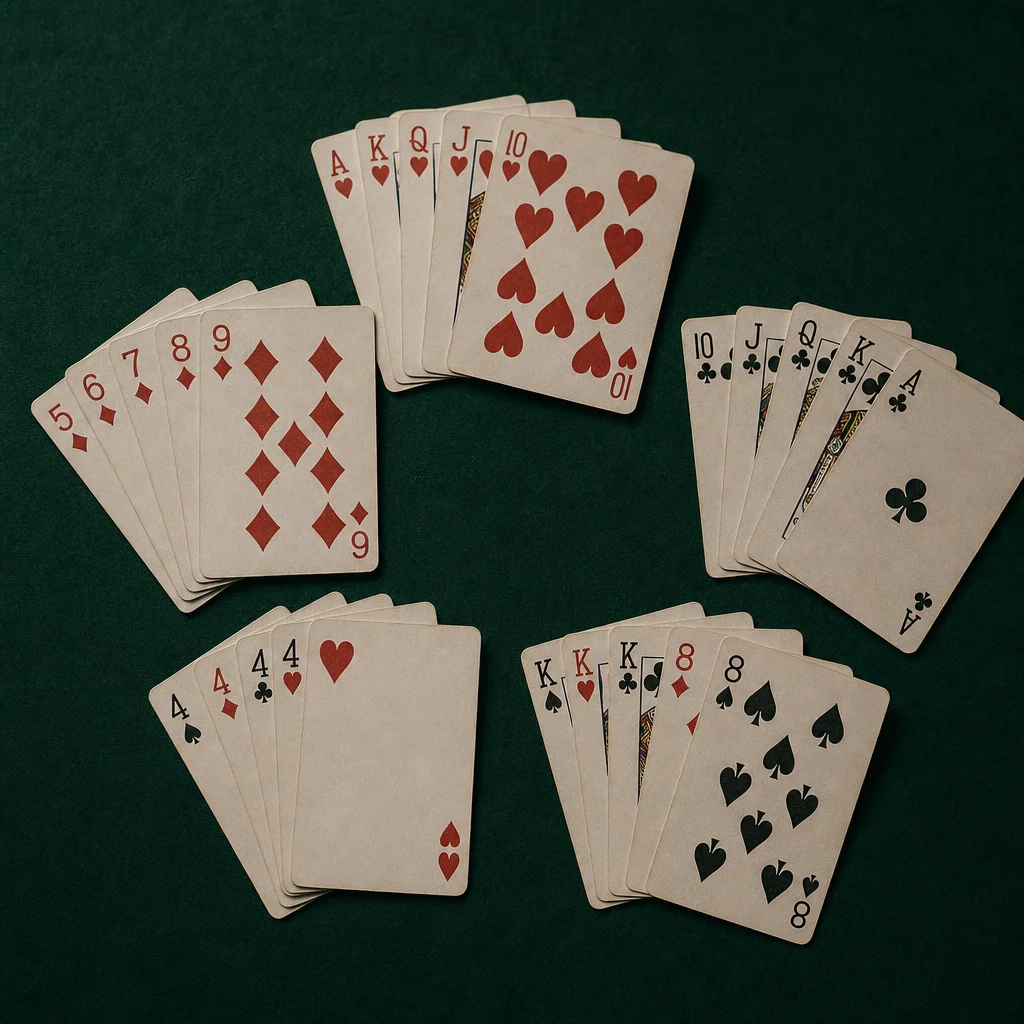
What Defines a Poker Hand Category
A hand category groups together every five-card combination that shares the same structural pattern. For example, any five cards of one suit counts as a flush, regardless of which suit or which ranks are involved. This is the core of the poker hands definition used across nearly every variant of the game, from Texas Hold'em to Seven Card Stud. Furthermore, the category system stays constant even though the specific cards in play change from hand to hand.
Standard poker recognizes seven broad category types once one-pair and no-pair hands are counted separately. Some of these, such as four of a kind and three of a kind, involve matching ranks. Others, such as straights and flushes, involve sequence or suit rather than matching ranks. Understanding poker hands meaning starts with recognizing which of these two patterns — matching ranks or matching structure — a given hand follows.
Poker Hands Names and What Each Category Covers
The table below lists common poker hands names alongside a short description of the pattern each one requires. This is not the highest-to-lowest ranking order — it is simply a reference to what each category means on its own terms.
| Hand Category | Defining Pattern | Example |
|---|---|---|
| Four of a Kind | Four cards of the same rank | 9♠ 9♥ 9♦ 9♣ 2♠ |
| Full House | Three of a kind plus a separate pair | K♠ K♥ K♦ 4♣ 4♠ |
| Flush | Five cards of one suit, any sequence | 2♣ 6♣ 9♣ J♣ A♣ |
| Straight | Five cards in sequence, mixed suits | 5♠ 6♥ 7♦ 8♣ 9♠ |
| Three of a Kind | Three cards of the same rank | 7♠ 7♥ 7♦ Q♣ 2♠ |
| Two Pair | Two separate matching pairs | J♠ J♥ 4♦ 4♣ 8♠ |
| One Pair | Two cards of the same rank | A♠ A♥ 6♦ 9♣ 2♠ |
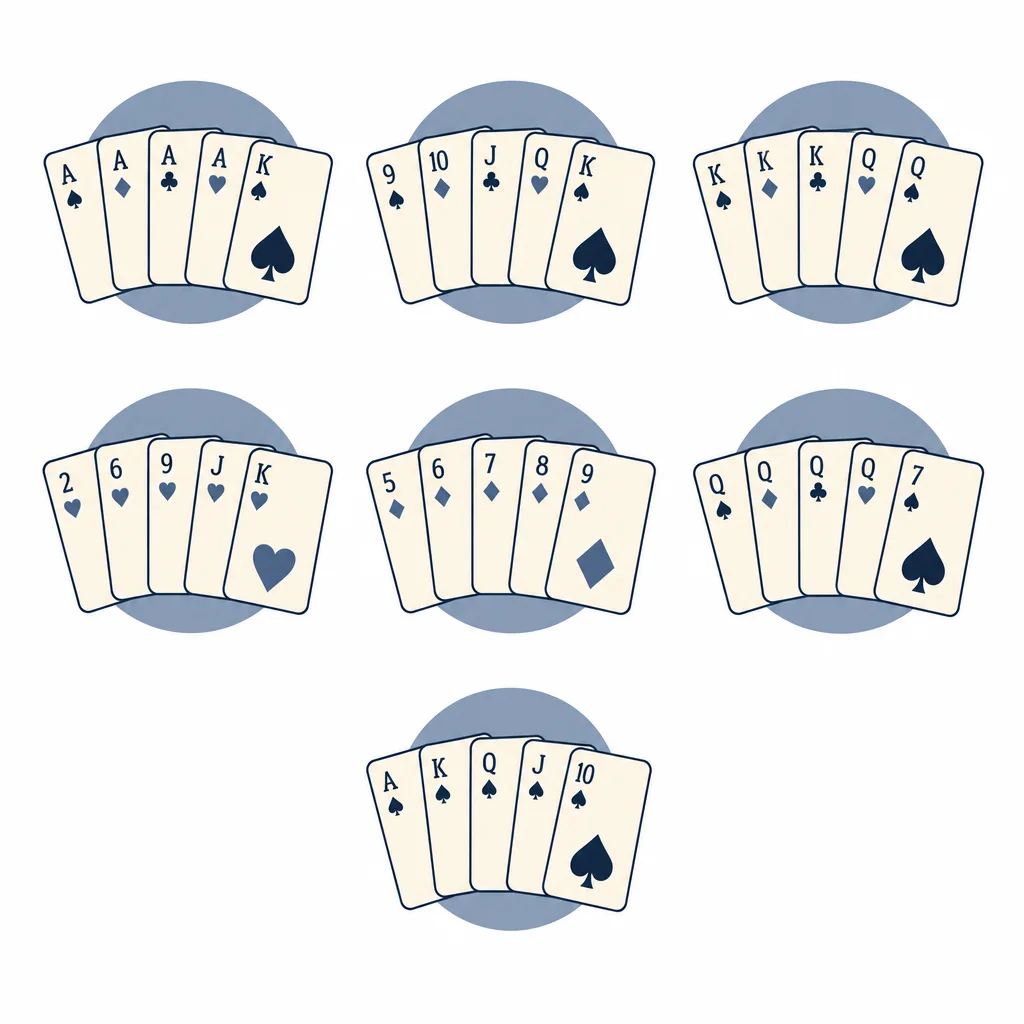
How This Portal Organizes the Hand Categories
This section works as a portal rather than a single deep-dive article. Three of the categories above — four of a kind, three of a kind, and one pair — live on their own dedicated pages under the hand-rankings section, since each involves matching-rank rules worth explaining in detail. The remaining categories, including full houses, flushes, straights, and two pair, each get a separate entry page as well, so readers can jump straight to the hand type they're researching.
For the complete best-to-worst order across all seven categories, the poker hands in order page lays out the full sequence with tiebreaker rules. Readers comparing two specific hands head-to-head — for instance, whether a flush beats a straight in every case — can check the what beats what page for direct matchup verdicts. Neither ranking order nor matchup outcomes are the focus here; this page exists to define the categories themselves before a reader moves on to those comparisons.
Category vs. Ranking
Why the Category System Stays Consistent Across Variants
Texas Hold'em, Omaha, and Seven Card Stud all use the same seven-category system, even though the number of cards dealt to each player differs. A player in Omaha receives four hole cards instead of two, yet the final hand shown at showdown still uses exactly five cards and still falls into one of the same categories. Therefore, learning the category definitions once means a reader can apply that same knowledge across nearly any poker variant without relearning the basics.
Some home games and casual variants add novelty categories, such as treating certain wild-card combinations as a special hand. However, standard poker rules recognize only the seven categories described above. Any variant that departs from this standard usually states so explicitly in its house rules, which is a useful signal for spotting non-standard games. Readers who want the canonical write-up can consult Wikipedia's list of poker hands.
Related Articles
Frequently Asked Questions
What are poker hands?
What does poker hands mean?
How do poker hands work?
What are some poker hands?
How many poker hands are there?
- Flush in Poker: Definition, Tie-Breakers and ProbabilityA flush in poker is five same-suit cards. See how ties break, what a nut flush means, and…
- Four of a Kind (Quads): Rules, Odds and KickersFour of a kind in poker means four cards of one rank plus a kicker. See the exact odds, ho…
- Full House in Poker: Composition, Ties and OddsA full house poker hand ranks by its three-of-a-kind first, then its pair. See how ties br…
- High Card in Poker: When the Weakest Hand WinsHigh card poker hands settle showdowns when no pair or better appears. See how five kicker…
- Highest Hand in Poker: Top of the HierarchyThe highest hand in poker is the royal flush. See what ranks second, third, and how wild c…
- One Pair in Poker: Rules, Kickers and RankingOne pair poker hands rank by pair value, then by kickers when pairs tie. Learn the rules t…
- Poker Hand Rankings by Variant: Omaha, Razz, Short DeckSee how poker low hand rankings work in razz, lowball, and short deck, and how Omaha and p…
- Poker Hands in Order from Highest to LowestSee all poker hands in order, from royal flush down to high card, with one example for eac…
- Royal Flush: Definition, Odds and ExamplesA royal flush is the highest hand in poker: A-K-Q-J-10 of one suit. Learn its exact odds,…
- Straight Flush: Rules, Rarity and RankingA straight flush is five suited cards in sequence. Learn how it forms, how ties break, and…
- Straight in Poker: Rules, Ace Sequences and ExamplesLearn how poker hands straight work: five consecutive ranks, ace-high and ace-low runs, an…
- Three of a Kind (Trips and Sets): Rules and RankingThree of a kind poker hands rank above two pair and below a straight. Learn the rules, how…
- Two Pair in Poker: Rules, Kickers and Tie-BreakersTwo pair poker rules explained: which pair ranks first, when the kicker decides, and what…
- What Beats What in Poker: Head-to-Head MatchupsConfused about what beats what in poker? See clear verdicts for flush vs straight, quads v…