

How to Remember Poker Hands
Knowing how to remember poker hands is a separate skill from knowing the rankings themselves. A player can read the list of ten categories once and still freeze at the table when a flush and a straight land on the same board. This entry covers the retention side: the mnemonic devices, grouping logic, and drilling methods that move hand order from short-term recognition into automatic recall. For the ranking list itself, see the dedicated poker hands in order reference.
Mnemonic Devices for Poker Hands
A poker hands mnemonic works by turning an abstract list into a phrase, acronym, or story the brain finds easier to hold onto. One common approach chains the first letter of each hand, from high card up to royal flush, into a sentence that gets repeated until it sticks. Another approach uses a short story where each hand becomes a character or event in a fixed sequence, since narrative order is naturally easier to recall than a flat list.
- Acronym chaining: build one sentence from the first letter of each hand category in order
- Story linking: attach each hand to a scene in a short, absurd mental story
- Number pegging: pair each hand with its rank number (1 through 10) using a fixed peg image
- Chunking: group hands into pairs (e.g. straight/flush, full house/quads) to cut the list to five units
Why Chunking Helps
The Grouping Logic Behind Hand Order
Hand order is not arbitrary, and understanding the grouping logic makes it far easier to retain than pure memorization. Hands are ranked from rarest to most common, so the order itself encodes a pattern: pair-based hands (pair, two pair, three of a kind, full house, four of a kind) sit on one track, while sequence- and suit-based hands (straight, flush, straight flush) sit on another. A royal flush closes the list as the single rarest case of a straight flush.
Recognizing which track a hand belongs to cuts the recall problem in half, since the player only needs to place a hand within five items rather than ten. This entry focuses on that structural logic rather than the exact combinatorics behind each hand's rarity, which the poker odds and probability guide covers in depth.
| Track | Hands (low to high) | Shared Feature |
|---|---|---|
| Pair-based | Pair, Two Pair, Trips, Full House, Quads | Matching ranks, no sequence needed |
| Sequence/suit-based | Straight, Flush, Straight Flush, Royal Flush | Consecutive ranks and/or matching suits |
Drilling Methods That Build Fast Recall
A mnemonic gets the order into memory once, but drilling is what makes recall fast enough for live play. Spaced repetition, where a player reviews the list at growing intervals (one day, three days, one week), moves the ranking from conscious recall into near-automatic recognition. Flashcard-style self-testing, where a player is shown two hands and must instantly name the winner, trains the comparison skill directly rather than just the list order.
- Recite the full order from memory once daily for the first week
- Self-test with random hand pairs and time each answer to under three seconds
- Review any pair-based versus sequence-based comparison that causes hesitation
- Space repetitions out over days, not hours, to build longer-term retention
- Practice against real hand histories or hand-ranking quizzes to add context
Common Retention Mistakes
The most frequent error is treating the list as ten unrelated items rather than two related tracks, which doubles the practical memory load for no reason. A second common mistake is stopping practice as soon as the order can be recited slowly, without ever drilling the fast, side-by-side comparisons that actual hands require at the table.
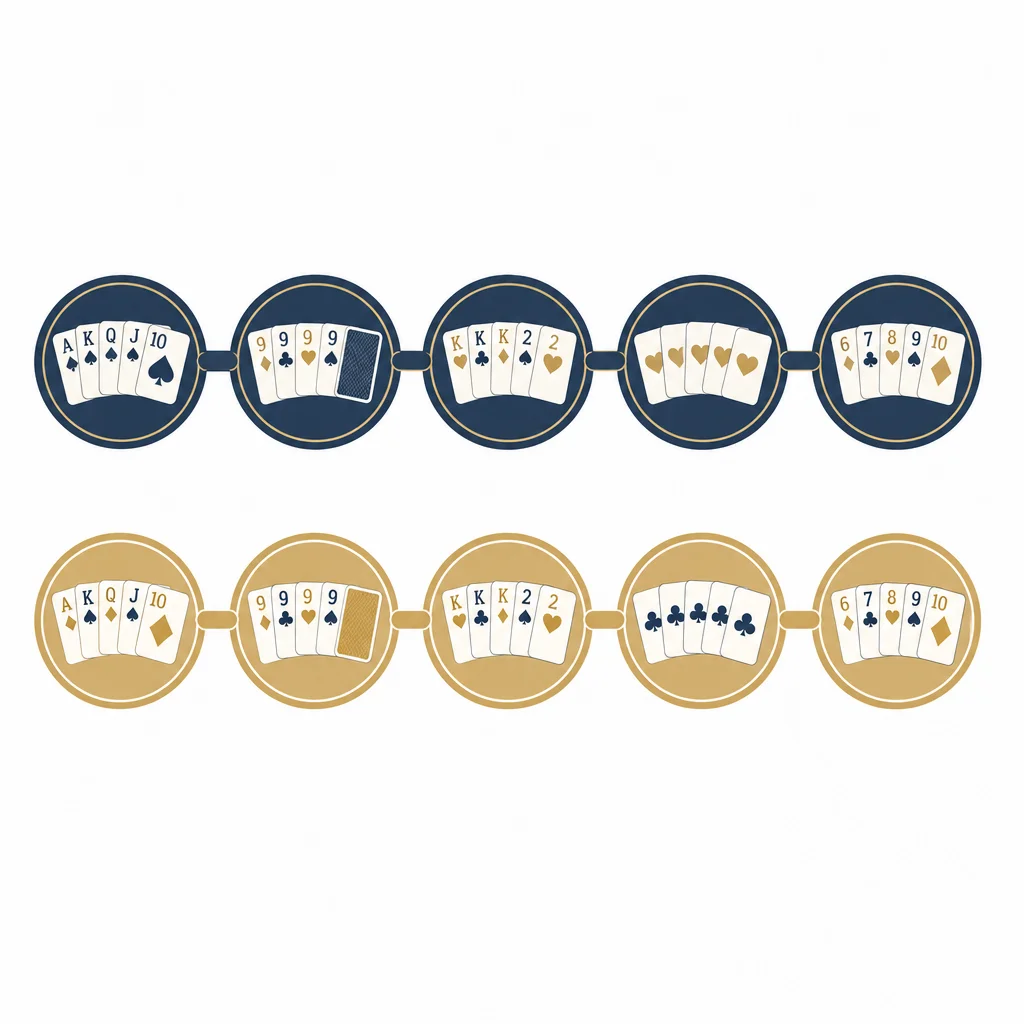
Retention comes from combining a memory device with repeated, timed practice rather than from either one alone. Once the order feels automatic, spending time on the underlying probabilities sharpens judgment further; the frequency logic behind each hand's rarity lives in the linked odds and probability guide, while the exact ranking list stays in its own reference entry. An independent reference worth bookmarking is Wikipedia's poker article.