

Poker Hand Rankings: The Official Hierarchy
Poker hand rankings are the fixed hierarchy that determines which five-card hand beats another in nearly every variant played today. The system exists because poker is fundamentally a game of comparison: whoever holds the highest-ranked hand at showdown wins the pot, regardless of how the cards were acquired. Official poker hand rankings apply across Texas Hold'em, Omaha, and seven-card stud, which is why the hierarchy is often called the standard poker hand rankings or the poker hand hierarchy.
This portal explains why the hierarchy is built the way it is and what actually decides which hand sits above another. For the full list of hands from best to worst, the poker hands in order page covers that ranking directly. For how each of the seven core hands is built from its cards, the hands section breaks down composition rules one hand at a time.
Why a Hand Hierarchy Exists
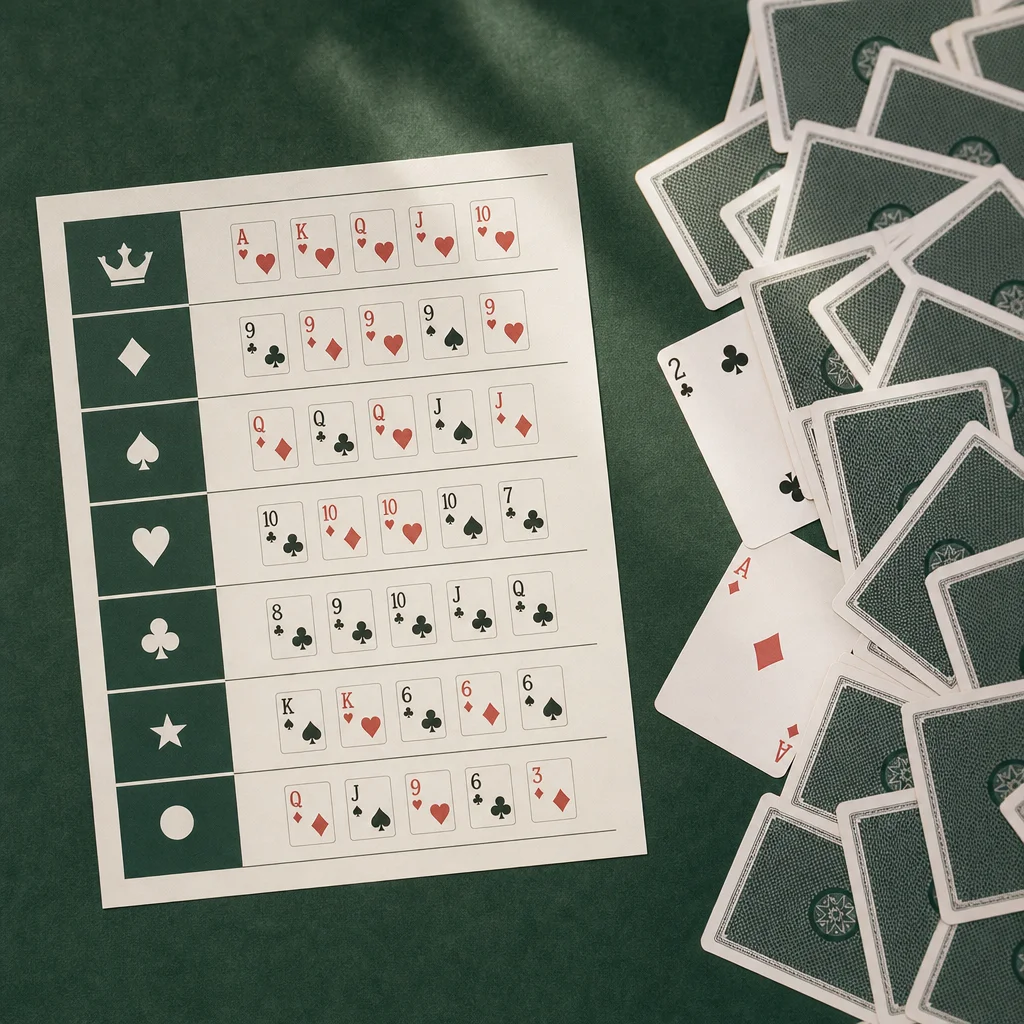
A card game needs an agreed way to settle who wins when two players show different hands. Poker solves this with a ranking system rather than a point count, because a ranking is faster to compare at the table and works the same whether the pot holds two dollars or two million. Every recognized poker hand rankings chart, from a casino wall poster to a mobile app tutorial, lists the same nine categories in the same order, because the order isn't a house rule. It follows directly from mathematics.
How Rarity Sets the Order
The core principle behind the poker hand hierarchy is simple: the rarer a hand type is, the higher it ranks. A standard 52-card deck produces exactly 2,598,960 possible five-card hands, and each hand category occupies a fixed share of that total. A royal flush appears in only 4 of those 2,598,960 combinations, giving it odds of roughly 649,739 to 1 against. Four of a kind, by contrast, has 624 possible combinations, making it far more common than a royal flush but still rare enough to rank near the top. This inverse relationship, fewer combinations mean a higher rank, holds true across every category in official poker hand rankings, with no exceptions.
| Hand Category | Combinations | Probability |
|---|---|---|
| Royal Flush | 4 | 0.000154% |
| Straight Flush | 36 | 0.00139% |
| Four of a Kind | 624 | 0.024% |
| Full House | 3,744 | 0.14% |
Reading a Poker Hand Rankings Chart
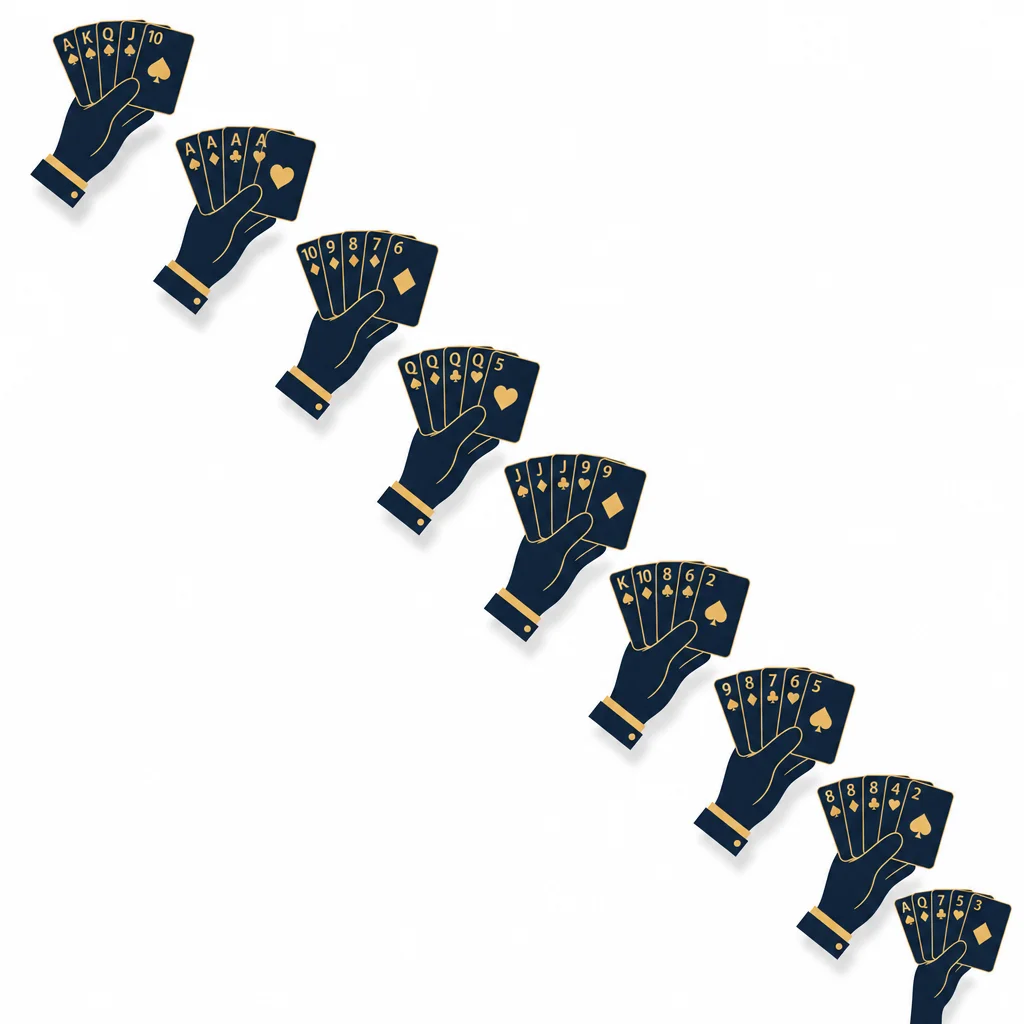
A poker hand rankings chart typically stacks all nine categories from rarest at the top to most common at the bottom, often alongside the number of ways each hand can occur. This layout matters because it turns an abstract probability concept into something a new player can scan in seconds. Rather than memorizing why a flush beats a straight, a reader can see that a flush has fewer possible combinations than a straight and immediately understand the logic behind the placement.
Most charts also separate the nine standard categories from special or house-specific hands, since games with wild cards can introduce combinations, like five of a kind, that fall outside the traditional structure.
Are Poker Hand Rankings Based on Probability?
Yes. Every position in the standard poker hand rankings reflects how many ways that hand can be formed from a 52-card deck, not tradition or arbitrary preference. A hand that can be made in fewer ways sits higher because a rarer hand is statistically harder for an opponent to also hold or beat. This is also why the same nine-category order applies in Texas Hold'em, Omaha, and stud games alike: the underlying deck and combinatorics don't change between variants, so the ranking logic doesn't either.
Why Rank Order Never Changes
When the Hierarchy Changes
The standard hierarchy assumes a 52-card deck with no wild cards, which covers the vast majority of poker played worldwide. Introducing wild cards, as in some home-game variants, adds combinations like five of a kind that outrank a royal flush, and games using a shortened deck, such as six-plus hold'em, compress the probabilities enough to reorder flushes and full houses. These are exceptions worth knowing exist, but they don't change the official poker hand rankings used at the table in standard cash games and tournaments.
Understanding why the hierarchy exists, rather than just memorizing it, makes the rankings far easier to recall under pressure. Once the probability logic clicks, a reader no longer needs to guess whether a full house or a flush wins. The rarer combination always does. For the complete ordered list of all nine hands with examples, visit the poker hands in order page next. An independent reference worth bookmarking is Wikipedia's list of poker hands.
Sources
Related Articles
Frequently Asked Questions
What are poker hand rankings?
How do poker hand rankings work?
How many poker hand rankings are there?
Are poker hand rankings based on probability?
How are poker hands ranked?
- Flush in Poker: Definition, Tie-Breakers and ProbabilityA flush in poker is five same-suit cards. See how ties break, what a nut flush means, and…
- Four of a Kind (Quads): Rules, Odds and KickersFour of a kind in poker means four cards of one rank plus a kicker. See the exact odds, ho…
- Full House in Poker: Composition, Ties and OddsA full house poker hand ranks by its three-of-a-kind first, then its pair. See how ties br…
- High Card in Poker: When the Weakest Hand WinsHigh card poker hands settle showdowns when no pair or better appears. See how five kicker…
- Highest Hand in Poker: Top of the HierarchyThe highest hand in poker is the royal flush. See what ranks second, third, and how wild c…
- One Pair in Poker: Rules, Kickers and RankingOne pair poker hands rank by pair value, then by kickers when pairs tie. Learn the rules t…
- Poker Hand Rankings by Variant: Omaha, Razz, Short DeckSee how poker low hand rankings work in razz, lowball, and short deck, and how Omaha and p…
- Poker Hands in Order from Highest to LowestSee all poker hands in order, from royal flush down to high card, with one example for eac…
- Royal Flush: Definition, Odds and ExamplesA royal flush is the highest hand in poker: A-K-Q-J-10 of one suit. Learn its exact odds,…
- Straight Flush: Rules, Rarity and RankingA straight flush is five suited cards in sequence. Learn how it forms, how ties break, and…
- Straight in Poker: Rules, Ace Sequences and ExamplesLearn how poker hands straight work: five consecutive ranks, ace-high and ace-low runs, an…
- Three of a Kind (Trips and Sets): Rules and RankingThree of a kind poker hands rank above two pair and below a straight. Learn the rules, how…
- Two Pair in Poker: Rules, Kickers and Tie-BreakersTwo pair poker rules explained: which pair ranks first, when the kicker decides, and what…
- What Beats What in Poker: Head-to-Head MatchupsConfused about what beats what in poker? See clear verdicts for flush vs straight, quads v…