
Straight in Poker: Rules, Ace Sequences and Example Hands
A straight is a poker hand made of five cards with consecutive ranks that are not all the same suit. Among poker hands, straight combinations rank above three of a kind and below a flush in most standard hand-ranking systems. Because a straight depends only on rank sequence, suits play no role in forming it or in judging its strength.
This entry covers the poker rules straight hands must satisfy, how the ace behaves at both ends of a sequence, and how two straights compare when players show them down together. For how a straight stacks up against a flush or other hands, see the hand comparison guide. For the suited version of this hand, see the straight flush entry.
What Counts as a Straight in Poker
The rules of poker straight formation require five cards in unbroken rank order, drawn from at least two different suits. A hand such as 5-6-7-8-9, with at least one suit break somewhere among the five cards, qualifies as a straight. If all five cards share one suit, the hand becomes a straight flush instead, which sits in a higher category entirely.
Card rank alone determines whether a sequence is valid. Suit symbols never factor into the order — a club, a heart, a diamond, and a spade can sit side by side in the same run without disrupting it. This is one of the more common points of confusion for newer players learning poker terms straight hands rely on. Community-card games add a layer of complexity, since a five-card straight can be built entirely from the board, entirely from a player's own two cards mixed with the board, or from any workable combination between the two.
Ace-High and Ace-Low Straights
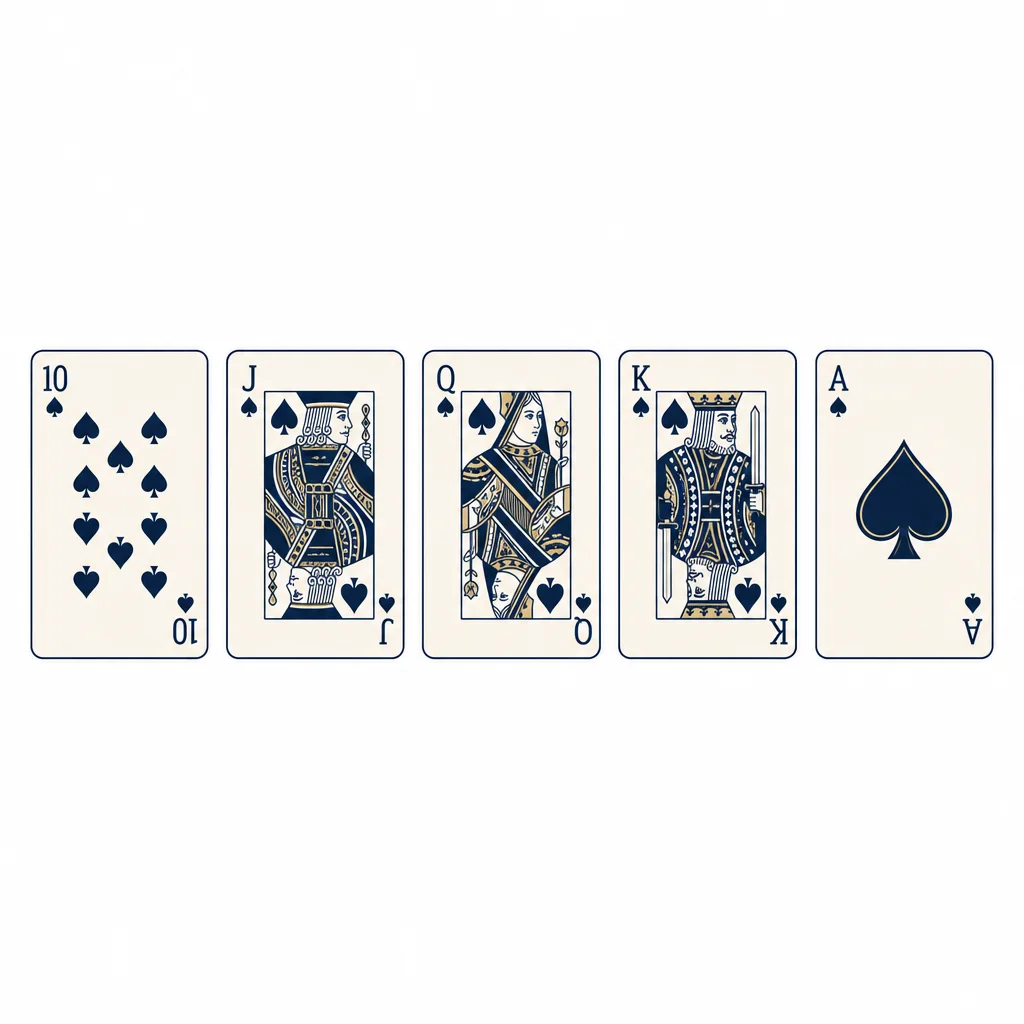
The ace occupies a unique position in straight formation because it can serve as the highest card or the lowest card in a sequence, though never both within the same five-card run. An ace-high straight — ten, jack, queen, king, ace — is the strongest possible straight. An ace-low straight, sometimes called the wheel, runs ace, two, three, four, five, and ranks as the weakest straight available.
The wheel treats the ace as a one for sequencing purposes only; its rank value elsewhere in the game stays unchanged. This dual role explains the poker straight rules king ace two confusion that trips up many players: a run of king, ace, two, three, four is not valid, because the ace cannot sit in the middle of a sequence and bridge the top and bottom of the deck at once.
| Sequence | Low Card | High Card | Straight Type |
|---|---|---|---|
| 10-J-Q-K-A | 10 | Ace | Ace-high (strongest straight) |
| 9-10-J-Q-K | 9 | King | King-high |
| 6-7-8-9-10 | 6 | 10 | Mid-range straight |
| A-2-3-4-5 | Ace (low) | 5 | Ace-low / wheel (weakest straight) |
How Competing Straights Are Compared
When two players hold a straight at showdown, the hand with the higher-ranking top card wins the comparison. A queen-high straight (8-9-10-J-Q) beats a jack-high straight (7-8-9-10-J), because the sequence tops out one rank higher. Suits carry no weight in this comparison, so a straight in hearts and an identical straight in clubs are worth exactly the same. If both players hold straights that top out at the identical rank — for example, both hold a king-high run built from a shared community board — the pot splits evenly between them, since no further tiebreaker exists once the top card matches.
Where This Sits in the Overall Ranking
Common Straight Sequences at a Glance
Ten distinct straights exist in a standard 52-card deck, ranging from the ace-low wheel to the ace-high broadway straight. Recognizing these sequences quickly helps at the table, particularly when reading the board in community-card games such as Texas Hold'em. Players who memorize this full list can scan a five-card board and judge, within a second or two, exactly which straights are possible for an opponent to hold. Readers who want the canonical write-up can consult Wikipedia's list of poker hands.
- Ace-low (wheel): A-2-3-4-5 — the lowest-ranked straight
- 6-high: 2-3-4-5-6
- 7-high: 3-4-5-6-7
- 8-high: 4-5-6-7-8
- 9-high: 5-6-7-8-9
- 10-high: 6-7-8-9-10
- Jack-high: 7-8-9-10-J
- Queen-high: 8-9-10-J-Q
- King-high: 9-10-J-Q-K
- Ace-high (broadway): 10-J-Q-K-A — the highest-ranked straight